
Rubber products are not only subject to mechanical pressure and abrasion over their service life. Oxygen, ozone, heat, light, and mechanical stress gradually alter the structure of rubber, reducing flexibility, increasing hardness, causing cracking, and degrading mechanical properties. This process, known as rubber aging, is one of the key factors limiting the service life of rubber parts and tires.
This is where antioxidants and anti-degradants come into the rubber formulation. By inhibiting oxidation reactions and reducing the effect of degrading factors, these materials slow the breakdown of polymer chains and help rubber maintain its performance over a longer period. Scientific studies also indicate that antioxidants are among the key additives for increasing the durability and reliability of rubber products.
Why Does Rubber Degrade Over Time?
Many industrial rubbers — particularly those containing double bonds, such as Natural Rubber (NR), SBR, and BR — are susceptible to oxidation and ozone attack. During oxidation, radical chain reactions occur within the polymer structure.
In simple terms, an initial reaction can generate free radicals. These radicals react with oxygen to form other reactive products, which then attack further sections of the polymer chain, continuing the reaction as a chain process. The result can be polymer chain scission, changes in the crosslink network, and ultimately a decline in mechanical properties.
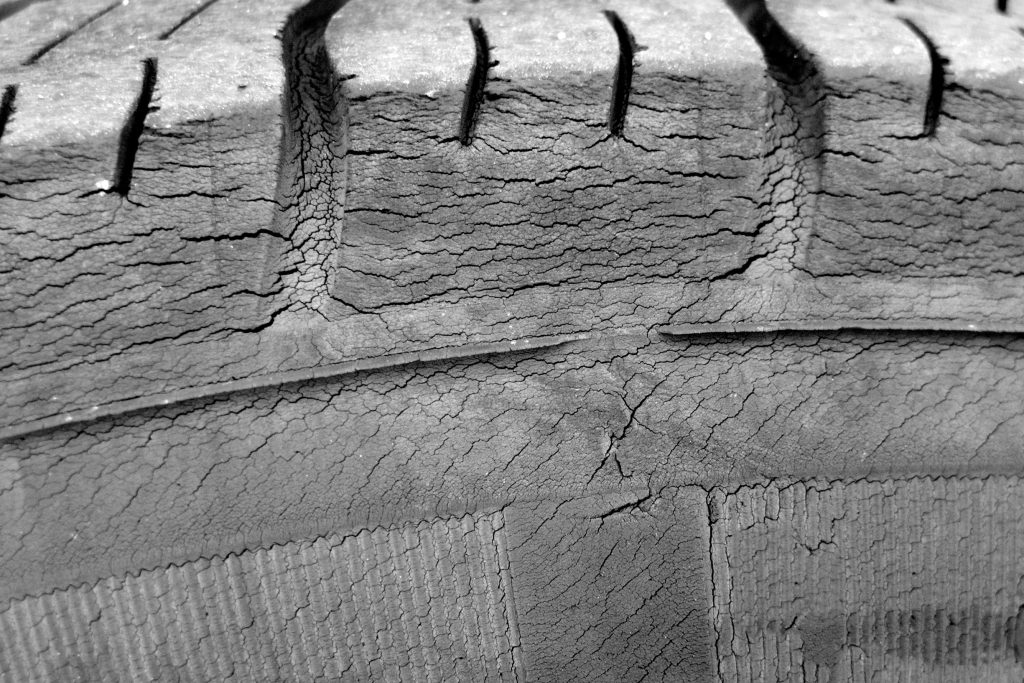
Ozone is also of particular significance for many unsaturated rubbers. Contact between rubber and ozone can produce surface cracks known as ozone cracking, which can propagate further if stress continues.
How Do Antioxidants Protect Rubber?
Antioxidants do not all work through a single mechanism, but their main purpose is to reduce the rate of degrading reactions.
Some antioxidants react with free radicals, interrupting the oxidation chain reaction. Others act protectively against oxidizing agents such as ozone.
For this reason, selecting the right antioxidant depends on the type of rubber, working conditions, temperature, the degree of exposure to oxygen and ozone, and the product’s expected service life.
Key Effects of Antioxidants in Rubber
| Antioxidant Role | Degrading Factor |
|---|---|
| Reducing oxidation chain reactions | Oxygen and thermal oxidation |
| Protecting sensitive rubber sections from ozone attack | Ozone |
| Slowing thermo-oxidative degradation | Heat |
| Inhibiting or terminating chain reactions | Free radicals |
| Better preservation of mechanical and elastic properties | Long-term aging |
Three Important Antioxidants in the Rubber Industry
Various compounds are used in the rubber industry to control degradation. Among them, 6PPD, IPPD, and TMQ are well-known and widely used materials, although their performance and application areas are not entirely identical.
6PPD: An Important Protector of Rubber Against Ozone
6PPD, with the full name N-(1,3-dimethylbutyl)-N′-phenyl-p-phenylenediamine, is one of the most important anti-degradants used in the tire industry.
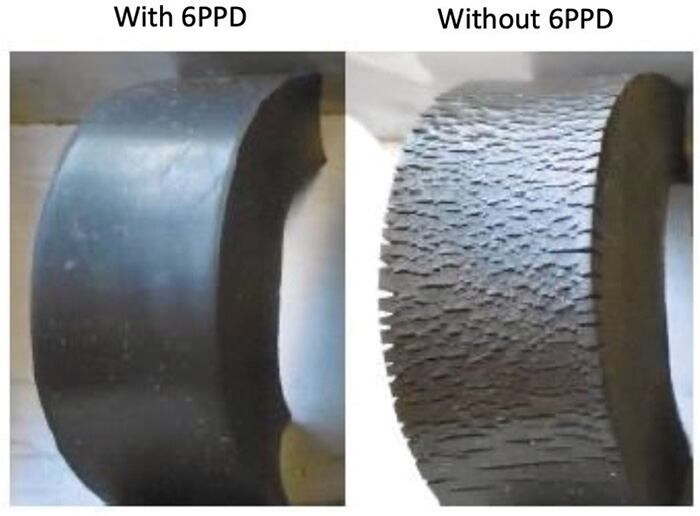
In addition to its antioxidant role, this material also functions as an antiozonant and is significant for protecting rubber against the destructive effects of ozone. Its presence in tire formulations helps reduce surface degradation and increase rubber durability.
The mechanism of 6PPD’s action can largely be attributed to its reaction with oxidizing agents and ozone. In effect, this anti-degradant material acts to some extent as a “chemical defense layer” for sensitive rubber sections.
There is, however, an important consideration: when 6PPD reacts with ozone, it can convert into 6PPD-quinone (6PPD-Q). This conversion product has received considerable attention from researchers in recent years due to its environmental effects, particularly in aquatic environments.
Therefore, when evaluating 6PPD, two aspects must be considered simultaneously: its important role in increasing rubber durability, and the environmental concerns related to its conversion products.
IPPD: An Effective Antiozonant
IPPD, or N-Isopropyl-N′-phenyl-p-phenylenediamine, is another compound in the PPD family used as an antioxidant and, in particular, as an antiozonant in rubber.
Technical data and scientific sources indicate that IPPD is used in rubber products, especially tires, to protect against ozone-induced degradation.
Aging studies have also shown that the concentration and behavior of IPPD in rubber can be affected by thermal and environmental conditions. This underscores the importance of selecting the appropriate antioxidant and evaluating its stability within the rubber matrix.
TMQ: Protection Against Thermal Aging
TMQ, or Polymerized 2,2,4-trimethyl-1,2-dihydroquinoline, belongs to the quinoline family of antioxidants and differs in chemical structure from 6PPD and IPPD.
One of TMQ’s important applications is protecting vulcanized rubber against heat and thermo-oxidative aging. The ASTM D5376 standard specifies a method for determining the base nitrogen content in polymerized TMQ and addresses its use in protective materials for vulcanized rubber.
This property makes TMQ a common component in many rubber formulations, including those used in tires, alongside other anti-degradants.
Comparing 6PPD, IPPD, and TMQ
| Material | Chemical Family | Primary Role | Typical Application |
|---|---|---|---|
| 6PPD | P-Phenylenediamine | Antioxidant + Antiozonant | Tires and rubber products exposed to ozone |
| IPPD | P-Phenylenediamine | Antiozonant + Antioxidant | Tires and rubber parts |
| TMQ | Quinoline | Antioxidant and thermal protection | Vulcanized rubber and tires |
A technical comparison of these materials’ performance shows that 6PPD and IPPD perform very well in ozone and flex-fatigue resistance, while TMQ has a greater advantage in thermal and oxidative stability.
Antioxidant Performance Comparison Table
In the table below, a lower score indicates better performance.
| Material | Ozone Resistance | Flex-Fatigue Resistance | Heat Resistance | Volatility/Self-Oxidation |
|---|---|---|---|---|
| IPPD | 1–2 | 1 | 2–3 | 2 |
| 6PPD | 2 | 1–2 | 2–3 | 3–4 |
| TMQ | 6 | 4–5 | 1–2 | 2 |
Why Combining Multiple Antioxidants Matters
In a rubber product, degradation is usually not caused by a single factor alone.
A tire, for example, may simultaneously be exposed to heat, oxygen, ozone, mechanical stress, and abrasion. As a result, using a single anti-degradant with one specific function may not be sufficient for all conditions.
For this reason, rubber formulations often combine different materials to achieve broader protection.
An experimental study on natural rubber has shown that combining antioxidants — including 6PPD and TMQ — can affect the preservation of rubber’s mechanical properties under thermo-oxidative aging conditions.
This shows that in formulation design, the goal is not simply choosing one strong material, but building an anti-degradant system suited to the product’s working conditions.
Is More Antioxidant Always Better?
No. One important consideration in rubber formulation design is that increasing the amount of antioxidant does not necessarily result in a proportional increase in product life.
Antioxidants must be used in an appropriate amount, consistent with their solubility and compatibility within the rubber matrix. Excessive use can lead to issues such as blooming, migration, and extraction from the rubber.
Therefore, the goal in professional formulation is not to use the “maximum amount,” but to reach the right balance between protection, stability, processability, and final product performance.
How Do Antioxidants Extend Tire Life?
Tires are among the most complex rubber products in terms of working conditions. Throughout their service life, tires are exposed to temperature changes, oxygen, ozone, radiation, and mechanical stress.
Under these conditions, antioxidants help by slowing the rate of degrading reactions, allowing the rubber structure to retain its required properties for a longer period.
For this reason, the role of antioxidants is not limited to extending the “chemical life” of rubber. Better preservation of flexibility, crack resistance, mechanical properties, and functional performance can also result from properly controlling the aging process.
A New Challenge for the Rubber Industry: Performance Versus Environmental Considerations
In recent years, the subject of rubber antioxidants has entered a new phase.
6PPD is a significant example of this shift in perspective. Technically, this material is highly important for increasing tire durability and protection; however, its conversion to 6PPD-Q through reaction with ozone has raised environmental concerns. Scientific studies have shown that this compound can enter the environment through tire wear particles and has drawn attention in aquatic environments.
Recent scientific reviews, in addition to examining the formation and transport pathways of 6PPD-Q, are also seeking alternatives and strategies to reduce environmental effects.
Therefore, the future direction of the rubber industry is not moving solely toward “stronger antioxidants,” but toward developing materials that can simultaneously address durability, safety, performance, and environmental considerations.
Summary
Antioxidants are a key component of rubber product formulations, and by controlling oxidation reactions and degradation caused by environmental factors, they slow the aging process of rubber.
Among these, 6PPD and IPPD are particularly significant for their antiozonant and antioxidant performance, while TMQ plays an important role in protecting against thermal and oxidative aging. Selecting the right materials and combining them appropriately can help preserve rubber properties and extend the product’s service life.
The answer to the article’s central question — how do antioxidants increase the life and durability of rubber products — is that antioxidants stop or slow degrading chemical reactions, protecting rubber’s polymer chains against oxidation, ozone, and heat. As a result, the rate of property decline is reduced, and the product’s service life and durability are increased.
That said, antioxidant selection should be based on the type of rubber, working conditions, and formulation, since usage amount, compatibility, migration, and even the conversion products of the antioxidant itself all play a role in the product’s final performance and environmental assessment.
Antioxidants slow down the oxidation reactions that break down rubber’s polymer chains over time. By inhibiting these reactions, they help rubber retain its flexibility, strength, and resistance to cracking for a longer service life.
6PPD and IPPD are primarily antiozonants that protect rubber from ozone-related surface cracking, while also offering antioxidant properties. TMQ, by contrast, belongs to the quinoline family and is mainly used to protect rubber against heat and thermo-oxidative aging.
No. Adding antioxidant beyond the optimal amount does not proportionally extend product life and can cause issues such as blooming or migration out of the rubber. The right formulation balances protection, compatibility, and processability rather than maximizing quantity.








One Response