Introduction
Natural rubber is one of the most important raw materials in modern industry, playing an essential role in the production of vehicle tires, medical equipment, industrial components, conveyor belts, hoses, and hundreds of other products. Despite the expansion of synthetic rubber production, many industries still rely heavily on natural rubber because of its unique mechanical properties. But the key question is this: where does most of the world’s natural rubber come from?
The answer reveals that the bulk of global natural rubber production is concentrated in a small number of countries, which means that climatic or economic changes in these nations can affect the entire global market. (ANRPC, 2025)
What Is Natural Rubber?
Natural rubber is produced from latex, the milky-white sap of the Hevea brasiliensis tree. This tree is native to South America, but today most of its plantations are located in Southeast Asian countries thanks to their favorable climate.
After being harvested from the tree, latex is processed and supplied to various industries in the form of sheets, blocks, or latex concentrate. Properties such as high flexibility, excellent tear resistance, and high tensile strength make natural rubber an irreplaceable material in many industrial applications. (FAO; ANRPC)
Which Region Produces Most of the World’s Natural Rubber?
According to official reports from the Association of Natural Rubber Producing Countries (ANRPC), more than 85 percent of the world’s natural rubber is produced in the Southeast Asia region.
A tropical climate, abundant rainfall, high humidity, and fertile soil create ideal conditions for growing rubber trees. As a result, the countries in this region have become the main hub of natural rubber production and export over the past decades, supplying the bulk of the world’s industrial demand. (ANRPC Statistical Report 2025)
The World’s Largest Natural Rubber Producers
Thailand: The World’s Largest Natural Rubber Producer
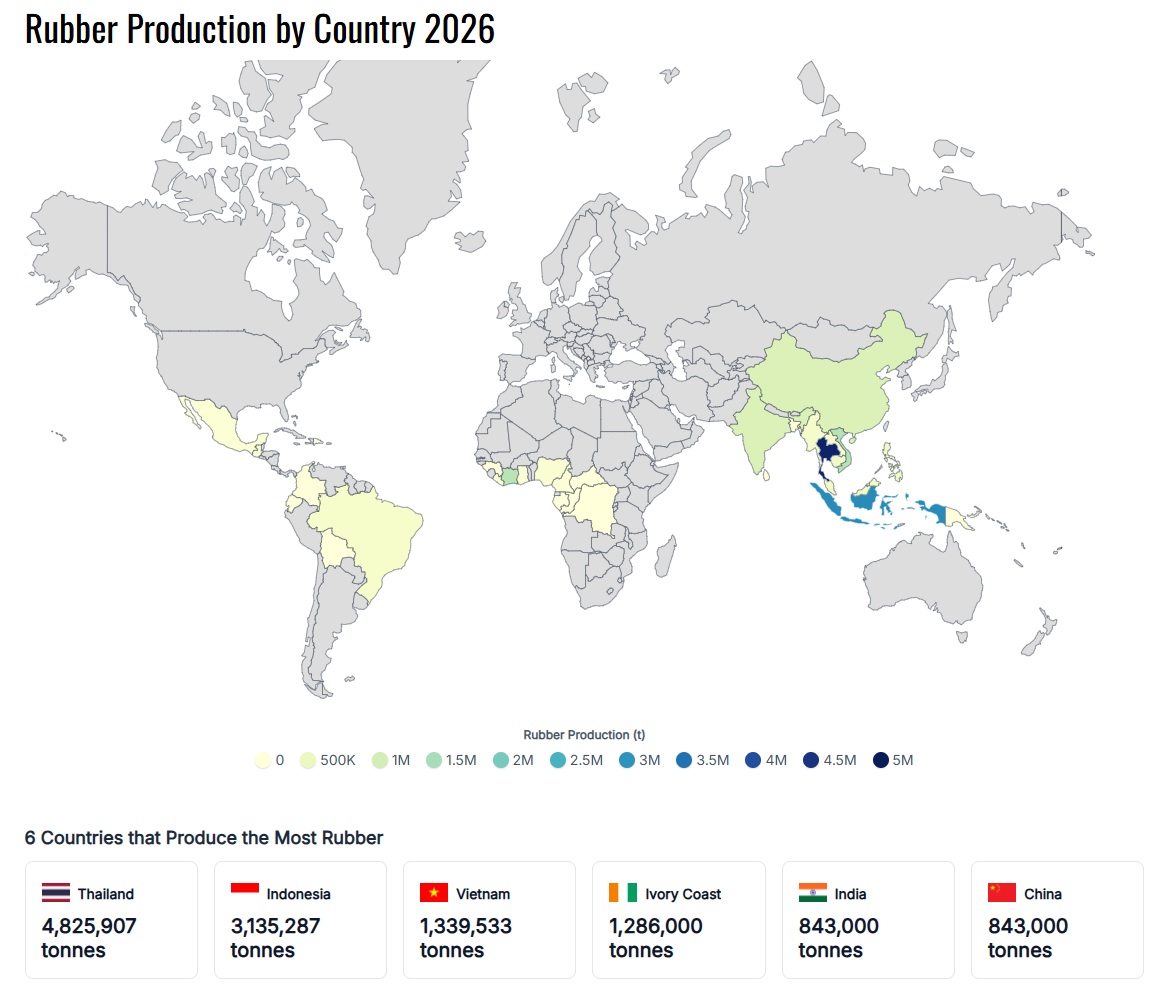
Thailand has held the top spot in global natural rubber production for years, producing millions of tons of natural rubber annually. A significant portion of this output is exported to China, Japan, the United States, and the European Union.
Extensive investment in agriculture, advanced latex-processing technology, and strong export infrastructure are among the most important factors behind the country’s success in the global rubber market. (ANRPC, 2025)
Indonesia
Indonesia is the world’s second-largest producer of natural rubber, with millions of hectares of rubber plantations across the country. A major share of Indonesia’s agricultural export revenue comes from natural rubber exports.
Although some land has been converted to palm oil cultivation in recent years, Indonesia remains one of the main suppliers to the global market. (ANRPC; FAOSTAT)
Vietnam
Over the past two decades, Vietnam has experienced remarkable growth in its natural rubber industry. The high quality of its latex and the development of its processing industries have turned the country into one of the world’s important exporters.
Today, many tire manufacturers and rubber industries around the world source part of their raw materials from Vietnamese producers. (ANRPC Statistical Report 2025)
Ivory Coast
In Africa, Ivory Coast is the largest producer of natural rubber. Increased foreign investment and the expansion of rubber plantations have boosted the country’s share of global exports in recent years.
Experts believe that Africa could claim a larger share of the global natural rubber market in the future. (FAOSTAT)
India and China
India and China are also important producers of natural rubber, but because of their very high domestic consumption, the bulk of their output is used within their own borders, and their export share is smaller than that of Southeast Asian countries.
China in particular—the world’s largest consumer of natural rubber—meets a significant part of its demand through imports. (ANRPC; Reuters 2025)
Why Is Southeast Asia the World’s Natural Rubber Production Hub?
The concentration of natural rubber production in Southeast Asia is no accident. In terms of climate, the region offers the best conditions for growing rubber trees.
The contributing factors include:
- A stable temperature between 25 and 35 degrees Celsius
- Abundant annual rainfall
- High humidity
- Suitable soil
- A long history of rubber tree cultivation
- A skilled workforce and competitive production costs
These same factors are why the largest volume of global natural rubber exports comes from this region. (FAO; ANRPC)
The Most Important Uses of Natural Rubber
According to global statistics, about 70 percent of the natural rubber produced is consumed by the tire manufacturing industry.
Other important uses include:
- Passenger vehicle tires
- Tires for construction machinery
- Aircraft tires
- Medical gloves
- Anti-vibration components
- Industrial belts
- High-pressure hoses
- Automotive rubber parts
- Medical and laboratory equipment
The widespread use of natural rubber across various industries means it remains a strategic commodity. (International Rubber Study Group; ANRPC)
The Future of the Natural Rubber Market
Forecasts suggest that with the growth of electric vehicle production, the expansion of transportation, and rising global tire demand, natural rubber consumption will also increase.
On the other hand, climate change, a declining cultivation area in some countries, rubber tree diseases, and rising production costs could constrain global supply. For this reason, many market analysts have raised the possibility of natural rubber prices increasing in the coming years. (Reuters, 2025; ANRPC Outlook Report)
Conclusion
In answer to the question “Where does most of the world’s natural rubber come from?” the answer is that more than 85 percent of the world’s natural rubber is produced in Southeast Asian countries, with Thailand being the largest producer of this valuable raw material in the world. Indonesia, Vietnam, Ivory Coast, India, and China rank among the other most important producers.
This concentration of production means that any change in the climatic, economic, or political conditions of Southeast Asian countries can directly affect the global price of natural rubber and related industries such as tire manufacturing, automotive production, and rubber component manufacturing.