Abstract
Rubber products and tires are continuously exposed to various degrading factors throughout their service life, including oxygen, heat, ozone, ultraviolet radiation, and mechanical stresses. These factors initiate oxidation and aging processes within the rubber structure, gradually reducing its physical and mechanical properties. Antioxidants are among the most important additives used in the rubber industry and play a fundamental role in preventing polymer chain degradation and extending the lifespan of rubber products. By scavenging free radicals and slowing oxidation reactions, these compounds help maintain the strength, flexibility, and performance of rubber materials over time. This article examines the mechanisms of rubber aging, the function of antioxidants, the different types of antioxidant systems, and their contribution to enhancing the durability and service life of rubber products.
Introduction
Rubber is one of the most important engineering materials used in transportation, automotive manufacturing, road construction, and industrial equipment. Despite its desirable properties such as flexibility, abrasion resistance, and mechanical strength, rubber is highly susceptible to environmental degradation over time. The primary cause of this deterioration is the oxidation of polymer chains resulting from exposure to oxygen, heat, and ultraviolet radiation. This process leads to reduced tensile strength, loss of elasticity, and the formation of surface cracks in rubber products (Al-Malaika, 2003).
To minimize the rate of degradation and improve product durability, compounds known as antioxidants are incorporated into rubber formulations. These additives are considered among the most critical ingredients in rubber compounding and play a decisive role in extending the service life of tires and other rubber products (Zhao et al., 2023).
Mechanism of Rubber Aging and Oxidation
Rubber aging is a complex process caused by various factors, including heat, oxygen, ozone, and light exposure. During this process, free radicals are initially generated within the polymer chains. These radicals react with oxygen to form hydroperoxides. Subsequently, hydroperoxide decomposition generates additional radicals, allowing degradation reactions to continue in a chain mechanism. The result is the deterioration of the polymer structure and a significant decline in the mechanical properties of rubber materials (Zhang et al., 2024).
The Role of Antioxidants in Preventing Rubber Degradation
Antioxidants protect rubber materials by reacting with free radicals and interrupting oxidative chain reactions. These additives function through two primary mechanisms. First, they neutralize free radicals before they can attack polymer chains. Second, they convert unstable hydroperoxides into more stable compounds, preventing the formation of new radicals.
As a result, the degradation rate is significantly reduced, allowing rubber products to retain their mechanical and physical properties for longer periods of service (Al-Malaika, 2003).
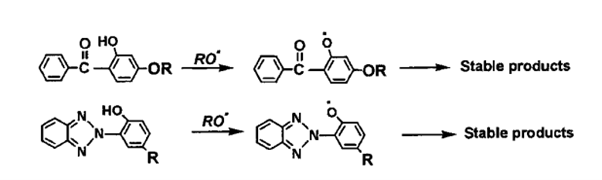
Figure 1.
Mechanism of ultraviolet absorbers and stabilizers in suppressing polymer degradation chain reactions (Al-Malaika, 2003).
Figure Description
This figure illustrates the mechanism through which stabilizers and antioxidants inhibit oxidative chain reactions. By eliminating reactive species and preventing the propagation of degradation processes, these compounds play a crucial role in improving the durability and long-term performance of polymers and rubber products.
Types of Antioxidants Used in the Rubber Industry
Rubber antioxidants are generally classified into three main categories:
Amine-Based Antioxidants
These compounds provide excellent resistance to oxidation and ozone degradation. They are widely used in tires and heavy-duty industrial rubber products due to their superior protective performance.
Phenolic Antioxidants
Phenolic antioxidants are among the most commonly used rubber stabilizers. They function by donating hydrogen atoms to free radicals, converting them into more stable and less reactive species.
Peroxide Decomposers
This group of antioxidants decomposes hydroperoxides formed during oxidation processes, preventing the generation of new radicals. Consequently, they contribute significantly to the thermal stability and durability of rubber compounds (Al-Malaika, 2003).
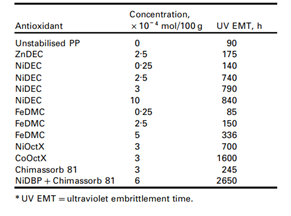
Table 1.
Comparison of the performance of different metal dithiolates in improving polymer light stability and reducing ultraviolet-induced degradation (Al-Malaika, 2003).
Table Description
The results presented in this table indicate that certain metallic stabilizers, particularly nickel-containing compounds, exhibit remarkable effectiveness in enhancing polymer resistance to ultraviolet degradation and significantly increasing the time required for material deterioration.
The Effect of Antioxidants on the Service Life of Rubber Products
One of the most significant advantages of using antioxidants is the extension of the service life of rubber products. Studies have shown that antioxidant additives help preserve tensile strength, reduce ozone-induced cracking, and maintain flexibility under various operating conditions.
In the tire industry, properly selected antioxidant systems can substantially increase product lifespan while reducing maintenance and replacement costs (Zhao et al., 2023).
Furthermore, antioxidants improve the thermal and light stability of rubber compounds and prevent the rapid loss of physical properties during long-term service. Research has demonstrated that effective stabilization systems can significantly enhance polymer resistance to oxidative and photo-induced degradation (Al-Malaika, 2003).
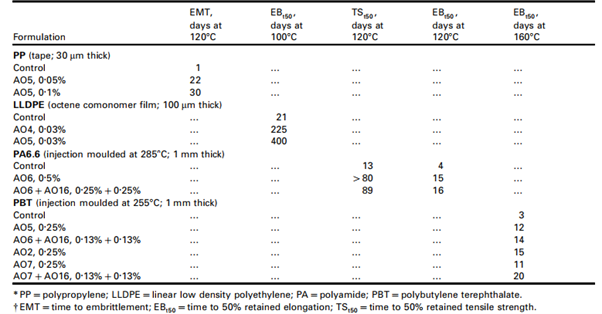
Table 2.
Comparison of stabilization systems in improving the long-term thermal stability of various polymers (Al-Malaika, 2003).
Table Description
This table summarizes studies related to the long-term thermal stabilization of different polymer materials. The findings demonstrate that appropriate antioxidant and stabilization systems can significantly improve resistance to thermal degradation while preserving the physical and mechanical properties of polymers throughout extended service periods. These results highlight the importance of selecting suitable antioxidant systems for maximizing the lifespan of rubber and polymer products.
Emerging Antioxidant Technologies in the Rubber Industry
Recent advancements in rubber technology have focused on the development of advanced antioxidants with greater stability and reduced migration tendencies. Among the most promising innovations are Hindered Amine Stabilizers (HAS), which possess regenerative capabilities and can continuously participate in free-radical scavenging cycles (Al-Malaika, 2003).
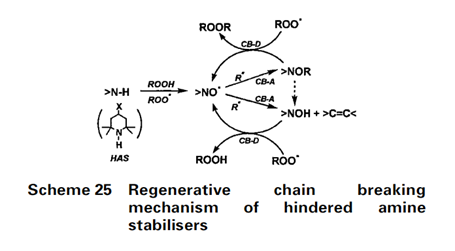
Figure 2.
Regeneration mechanism of hindered amine stabilizers (HAS) in suppressing degradation chain reactions (Xu et al., 2022).
Figure Description
This figure illustrates the regeneration cycle of nitroxyl radicals within hindered amine stabilizers. This unique characteristic enables long-term antioxidant activity and improved protection of rubber products against aging and degradation.
In addition, current research efforts are increasingly focused on polymeric antioxidants and environmentally friendly stabilization systems that not only improve product durability but also reduce the environmental impact associated with conventional antioxidant technologies.
Conclusion
Antioxidants are among the most important additives used in the rubber industry and play a critical role in extending the service life of rubber products. By inhibiting oxidation reactions, preventing free-radical formation, and slowing aging processes, these compounds help preserve the mechanical and functional properties of rubber over extended periods.
The use of properly designed antioxidant systems not only enhances the durability of tires and other rubber products but also reduces maintenance and replacement costs. Furthermore, the development of next-generation antioxidant technologies is creating new opportunities for manufacturing rubber products with improved longevity, reliability, and performance.
Keywords: Rubber Antioxidants, Tire Antioxidants, Rubber Aging, Rubber Oxidation, Tire Durability, Polymer Stabilizers
FAQ
Rubber antioxidants are chemical additives that protect vulcanized rubber compounds from degradation caused by heat, oxygen, ozone, and UV radiation. They preserve mechanical properties and significantly extend the service life of tires and rubber products.
TMQ (polymerized 2,2,4-trimethyl-1,2-dihydroquinoline) is one of the most widely used antioxidants in tire manufacturing. It provides excellent protection against heat aging and oxidative degradation in both natural and synthetic rubber compounds.
TMQ is a general-purpose antioxidant for heat and oxidative protection. 6PPD provides superior protection against ozone cracking and dynamic fatigue, making it standard in tire sidewall compounds. IPPD offers strong antiozonant activity particularly in static and semi-dynamic applications.
A: Antioxidants slow the degradation of polymer chains caused by environmental exposure and mechanical stress. This delays cracking, hardening, and loss of tensile strength, directly extending the operational life of tires under real-world conditions.