Introduction
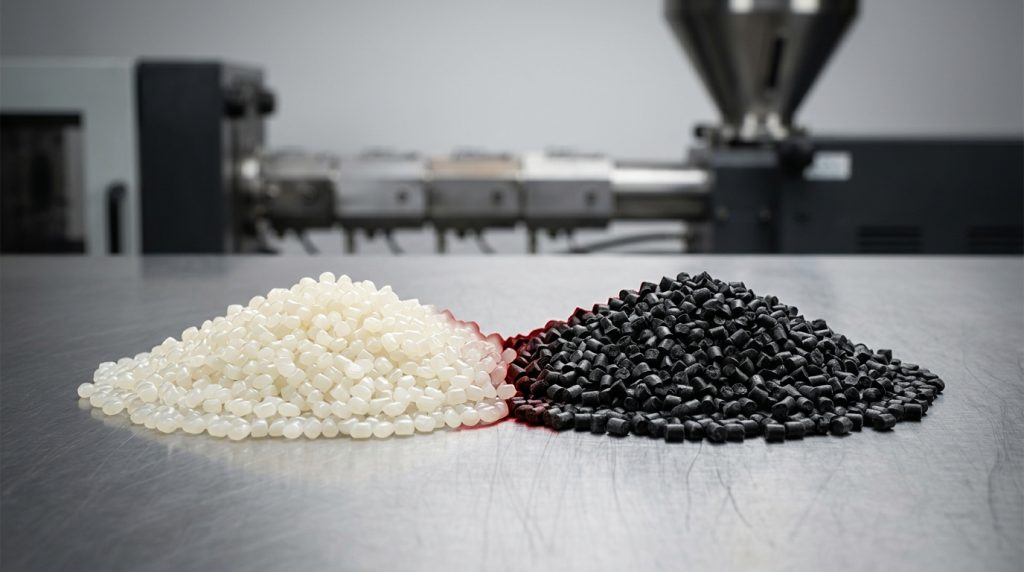
Two bags of granules sit side by side in the warehouse. One says PA6, the other PA66. They look almost identical, yet choosing the wrong one can mean a warped bracket, a cracked clip or a part that softens near the engine.
Polyamide 6 (nylon 6) and polyamide 66 (nylon 66) are the two most widely used engineering polyamides. Reinforce them with 30% glass fiber and you get PA6 GF30 and PA66 GF30, the workhorses of automotive and industrial parts.
This guide compares all four on the properties that decide real applications: heat, moisture, strength and cost. It ends with a practical selection guide and the questions buyers ask us most.
How PA6 and PA66 Differ at the Molecular Level
PA6 is made from a single monomer, caprolactam, through ring-opening polymerization. PA66 is made from two monomers, hexamethylenediamine and adipic acid, each with six carbon atoms. That pair of sixes is where the name “66” comes from.
The two-monomer structure gives PA66 a more regular, symmetrical chain. Regular chains pack more tightly into crystals, so PA66 melts roughly 40 °C higher than PA6.
The same chemistry explains a practical difference: PA66 generally costs more than PA6. Hamiico also supplies adipic acid, one of the two building blocks of PA66
PA6 vs PA66 vs GF30: Comparison Table
PA66 wins on heat, PA6 wins on toughness and cost, and 30% glass fiber more than doubles the strength of both.
| Property | PA6 | PA66 | PA6 GF30 | PA66 GF30 |
|---|---|---|---|---|
| Melting point (°C) | ~220 | ~260 | ~220 | ~260 |
| HDT at 1.8 MPa (°C) | ~65 | ~75 | 200-210 | 240-250 |
| Moisture at 23 °C, 50% RH (wt %) | 2.5-3.0 | 2.0-2.5 | 1.5-2.0 | Typically below PA6 GF30 |
| Tensile strength, dry (MPa) | 70-85 | 80-90 | 160-180 | 180-195 |
| Tensile modulus, dry (MPa) | ~3,000 | 3,200-3,500 | 9,500-11,000 | 9,500-10,500 |
| Melt processing range (°C) | 230-280 | 260-300 | 250-280 | 275-300 |
All values are typical for dry-as-molded specimens in published producer data. Two commercial grades with the same label can differ more than PA6 and PA66 do, so the technical datasheet (TDS) of the exact grade always has the final word.
Heat Resistance: Why Melting Point Is Not Enough
A loaded polyamide part fails from heat long before it melts. The number that predicts this is heat deflection temperature (HDT): the temperature at which a standard bar bends by a set amount under load.
The gap between the two numbers is large. Unreinforced PA6 melts at about 220 °C, yet its HDT at 1.8 MPa is only about 65 °C. Unreinforced PA66 does only slightly better, at about 75 °C.
Glass fiber changes the picture. The fibers form a rigid skeleton that holds the part’s shape as the polymer softens. That lifts HDT to 200-210 °C for PA6 GF30 and 240-250 °C for PA66 GF30, close to PA66’s own melting point.
HDT is a short-term test, not a service rating. Typical continuous-use limits are lower:
- Unreinforced PA6: about 80-100 °C.
- Heat-stabilized, glass-reinforced grades: about 120-150 °C.
- PA66 GF30 under moderate load: about 120-140 °C, with short excursions to 180-200 °C lasting minutes, not hours.
Above 220 °C, oxidation of the polyamide speeds up sharply whatever the glass content. As a working rule, if a part must live above 180 °C for long periods, specify PA66, preferably a heat-stabilized grade.
Moisture Absorption: The Difference That Matters Most in Practice
Both polyamides absorb water from the air, and this changes a part more than any other everyday factor. The amide groups in the polymer chain are polar and bond readily with water molecules. The process is reversible: drying removes the water and restores the original properties.
How much water, and what it changes
At 23 °C and 50% relative humidity, PA6 reaches about 2.5-3.0% water by weight and PA66 about 2.0-2.5%. Fully immersed, PA6 can take up 8-10%. Glass fiber lowers uptake in proportion to its share, so PA6 GF30 settles at about 1.5-2.0%.
Absorbed water acts as a built-in plasticizer:
- Strength and stiffness fall. In unfilled PA6, tensile strength and modulus drop 30-50% from dry to conditioned. In PA66 GF30, tensile strength falls from about 185 to 120 MPa, roughly 35%.
- Toughness rises. Impact strength and elongation at break can increase three to five times.
- Dimensions grow. Linear dimensions typically change by 0.5-0.8% from dry to equilibrium.
- The glass transition drops. PA6 falls from about 55 °C dry to near 0 °C when saturated.
For design, use conditioned property values, not dry-as-molded ones. A part that passes testing fresh from the mold may sag or drift out of tolerance after a humid season.
Why drying before molding is non-negotiable
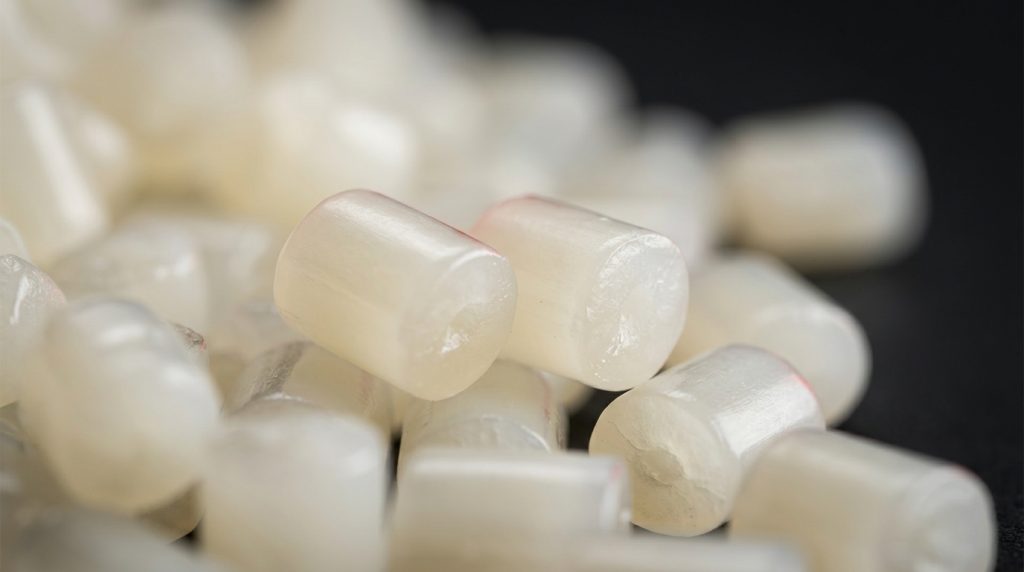
Moisture in the granules turns into steam in the barrel and breaks the polymer chains. The results are silver streaks on the surface, lower strength and brittle parts.
Typical guidance for PA6 is a residual moisture below 0.15-0.20%, reached in a desiccant dryer at about 80 °C for 3-4 hours. Glass-filled grades usually need 4-6 hours. PA66 GF30 is stricter still: below 0.10% before molding. Always follow the drying conditions in the grade’s TDS, and keep bags sealed until the material goes into the dryer.
What Does GF30 Mean, and What Does It Change?
GF30 means the compound contains about 30% glass fiber by weight. It is the most widely used reinforced grade because it balances stiffness, toughness and processability.
What you gain
- Strength: PA6 GF30 reaches 160-180 MPa, about 2.5 times unfilled PA6.
- Stiffness: tensile modulus rises from about 3,000 MPa to 9,500-11,000 MPa.
- Heat resistance under load: HDT climbs from about 65 °C to above 200 °C.
- Dimensional stability: mold shrinkage drops from 1.0-1.5% to 0.2-0.5%, and thermal expansion falls to roughly a third.
What you give up
- Ductility: elongation at break falls to about 3-4%. Sharp corners and stress points become places where cracks start.
- Uniform shrinkage: fibers align with the flow, so shrinkage across the flow can be about twice that along it. Complex parts may warp unless gates are placed with care.
- Tool life: glass is abrasive. Production molds above about 50,000 cycles need hardened steel, and wear-resistant screws are advisable.
- Surface finish and weight: fiber ends can show at the surface, and density rises to about 1.35-1.42 g/cm³.
Which Polyamide Should You Choose?
Start from the part’s operating temperature, load and humidity, and the material follows. PA6 is typically 10-20% cheaper per kilogram than PA66, so pay for PA66 only where heat or stiffness demand it.
| Application | Recommended grade | Why |
|---|---|---|
| Parts near the engine with sustained heat (intake manifolds, radiator end tanks) | PA66 GF30, heat-stabilized | Highest HDT; the safe choice for long exposure above 180 °C |
| Structural brackets and housings at normal temperatures | PA6 GF30 | Comparable strength at lower cost, wider processing window, better flow in thin walls |
| Large parts where appearance matters | PA6 GF30 | Smoother surface and easier filling than PA66 GF30 |
| Clips, cable ties, snap fits and impact-loaded parts | Unfilled PA6 | Best toughness and fatigue resistance, including at low temperature |
| Parts under constant load where creep matters | PA66 or PA66 GF30 | Higher stiffness and better creep resistance |
| Precision gears and parts that must hold tolerance in humid conditions | POM | Absorbs far less moisture than any polyamide |
When two options look close on paper, test molded parts in the conditioned state before approving the material.
Buying Tips: Specify the Grade, Not the Family
“PA6 GF30” names a family of materials, not a guaranteed set of properties. Before you order, pin down the details that actually decide performance.
- Name the exact grade. List the producer and grade code, plus any heat, UV or flame-retardant stabilization and the color.
- Compare datasheets on the same basis. Check whether values are dry-as-molded or conditioned, and that test methods and specimen thickness match.
- Never approve a substitute from the label alone. Two grades sold as PA66 GF30 can behave differently in your mold and in service.
- Ask for documents with every batch. A TDS for the grade and a certificate of analysis (COA) for the lot make incoming checks possible.
- Protect the material from moisture. Keep bags sealed until drying, and reseal part-used bags immediately.
Conclusion
There is no universally better polyamide, only a better fit for each part. PA66 GF30 earns its higher price where heat and sustained load meet. PA6 GF30 covers most structural parts at normal temperatures for less. Unfilled PA6 remains the choice when toughness matters most.
Whichever grade you choose, design with conditioned values and dry the granules before molding. Those two habits prevent most polyamide failures on the shop floor.
Hamiico supplies PA6, PA66, PA6 GF30 and PA66 GF30 from reputable Asian producers, with a datasheet for every grade. To compare grades for a specific part, contact our sales team.
FAQ.
Neither is better across the board. PA66 melts higher (about 260 °C vs 220 °C) and is slightly stiffer and stronger when dry. PA6 is tougher, processes at lower temperatures and typically costs 10-20% less. Choose PA66 for sustained heat above about 180 °C, and PA6 for impact-loaded or cost-sensitive parts.
GF30 means the polyamide contains about 30% glass fiber by weight. The fibers raise strength about 2.5 times, stiffness about three times and HDT to above 200 °C. In return, the material becomes less ductile, more abrasive to molds and more prone to uneven shrinkage.
About 220 °C for PA6 and about 260 °C for PA66. Glass fiber does not change the melting point, but it raises HDT at 1.8 MPa to 200-210 °C for PA6 GF30 and 240-250 °C for PA66 GF30. Continuous service limits are lower, typically 80-150 °C depending on grade and load.
Yes. At 23 °C and 50% relative humidity, PA6 absorbs about 2.5-3.0% water by weight and PA66 about 2.0-2.5%. Glass-filled grades absorb less. Water lowers strength and stiffness, raises toughness and changes dimensions by roughly 0.5-0.8%.
Moisture in the granules breaks the polymer chains in the hot barrel, causing silver streaks and weak, brittle parts. Typical targets are below 0.15-0.20% moisture for PA6 and below 0.10% for PA66 GF30, usually reached in a desiccant dryer at about 80 °C. Always follow the drying conditions in the grade’s TDS.